Deskripsi Meta: Banyak menara penerangan bergerak mengalami kebocoran hidrolik pada tiang, kemacetan, pengangkatan yang lambat, dan masalah pergeseran. Artikel ini menganalisis penyebab utama kegagalan dan membagikan metode pencegahan praktis untuk mengurangi biaya perawatan dan waktu henti di lokasi Anda.
1. Masalah (P): Masalah Umum yang Sering Dialami Pengguna Menara Penerangan pada Tiang Hidrolik
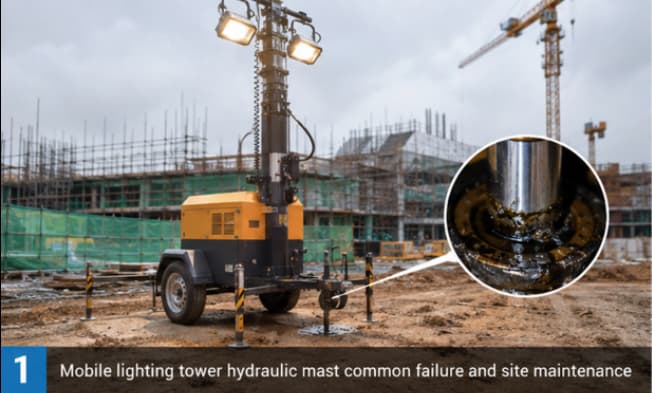
Bagi kontraktor konstruksi dan perusahaan penyewaan peralatan, tiang hidrolik adalah komponen yang paling sering mengalami kerusakan pada menara penerangan bergerak. Di lokasi kerja lapangan, banyak pengguna menghadapi masalah berulang: tiang hidrolik terangkat perlahan, macet di tengah jalan, bocor oli, atau tenggelam secara otomatis setelah mencapai ketinggian tertentu. Kegagalan ini secara langsung menyebabkan penundaan konstruksi, perawatan yang sering, biaya penggantian yang tinggi, dan tingkat pemanfaatan peralatan yang rendah.
Sebagian besar pembeli awalnya mengira masalah ini adalah cacat kualitas. Namun, sebagian besar kegagalan tiang hidrolik disebabkan oleh pengoperasian yang tidak tepat, oli hidrolik yang tidak sesuai, perawatan harian yang buruk, dan lingkungan kerja yang keras, bukan masalah manufaktur. Tanpa perawatan standar dan kebiasaan penggunaan yang benar, bahkan menara lampu kelas industri pun akan sering rusak.
2. Analisis (A): Penyebab Utama Kegagalan Tiang Hidrolik
Kami merangkum empat penyebab utama yang mengakibatkan kerusakan pada tiang hidrolik berdasarkan pengujian pabrik jangka panjang dan data purna jual.
2.1 Kontaminasi Oli Hidrolik dan Pemilihan Oli yang Tidak Tepat
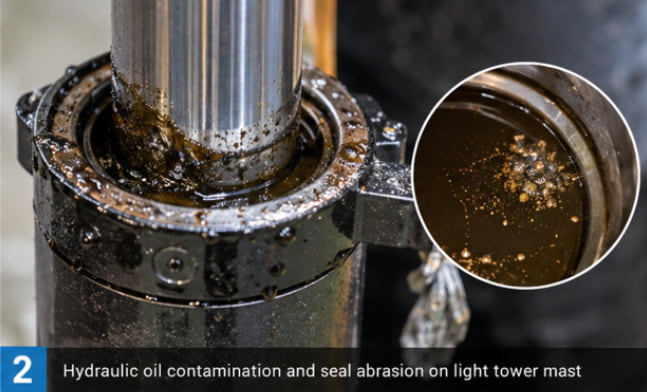
Oli hidrolik adalah media inti dari sistem pengangkatan. Banyak pengguna menggunakan oli hidrolik universal yang tidak cocok untuk suhu tinggi, suhu rendah, atau lingkungan berkabut garam di daerah pesisir. Oli yang kotor, bercampur dengan debu, air, dan partikel logam, akan menyumbat filter, menggores cincin penyegel, dan menyebabkan kebocoran internal silinder. Hal ini menyebabkan pengangkatan yang lambat, tekanan yang tidak mencukupi, dan kebocoran oli secara bertahap.
2.2 Abrasi Debu Eksternal dan Puing-puing Konstruksi
Lokasi konstruksi, area pertambangan, dan pekerjaan jalan mengandung banyak pasir, lumpur, dan debu. Saat menarik kembali tiang tanpa membersihkan permukaan batang, partikel keras masuk ke celah teleskopik dan mengikis struktur penyegelan. Keausan jangka panjang menyebabkan kerusakan permanen pada segel, yang merupakan penyebab utama kebocoran oli yang berulang.
2.3 Kerusakan Akibat Beban Berlebih dan Gaya Lateral
Tiang hidrolik dirancang hanya untuk beban vertikal. Banyak operator mengabaikan penyangga penstabil dan bekerja dalam kondisi angin kencang atau miring. Tekanan lateral terus-menerus menyebabkan sedikit deformasi tabung tiang, yang mengakibatkan pergerakan teleskopik yang tidak mulus, kemacetan, dan kerusakan struktural yang tidak dapat diperbaiki.
2.4 Kegagalan Reset Katup dan Penuaan Kelelahan Jangka Panjang
Katup bongkar muat yang tidak tertutup, katup periksa yang macet, dan sambungan selang yang menua akan menyebabkan hilangnya tekanan sistem. Hal ini menyebabkan fenomena "pengapungan tiang" yang khas, di mana menara perlahan tenggelam setelah diangkat. Getaran jangka panjang dan paparan luar ruangan mempercepat penuaan segel karet, meningkatkan kemungkinan kegagalan.
3. Resolusi (R): Solusi Pencegahan & Pemeliharaan Praktis
Lebih dari 90% kegagalan tiang hidrolik dapat dihindari melalui pengoperasian standar dan perawatan harian. Berikut adalah solusi praktis untuk armada penyewaan dan tim proyek.
3.1 Gunakan Oli Hidrolik Standar yang Sesuai dengan Iklim
Ganti oli hidrolik universal dengan oli hidrolik tahan suhu tinggi atau oli hidrolik tahan titik beku rendah sesuai iklim setempat. Untuk menara lampu sewaan yang sering digunakan, penggantian oli dan pembersihan filter secara menyeluruh dilakukan setiap 3–6 bulan. Oli hidrolik yang bersih memastikan tekanan stabil dan sangat mengurangi keausan internal silinder dan katup.
3.2 Bersihkan Batang Tiang Sebelum Ditarik Kembali
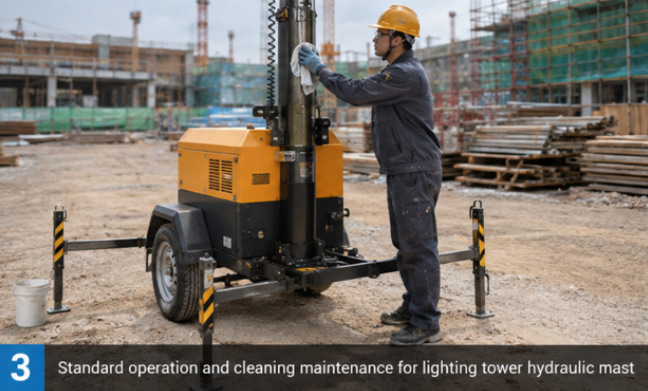
Bentuklah kebiasaan pengoperasian yang tetap: bersihkan debu, pasir, dan lumpur pada permukaan tiang sebelum ditarik. Langkah sederhana ini secara efektif menghindari abrasi partikel pada segel dan struktur teleskopik, sehingga memperpanjang umur pakai sistem hidrolik secara signifikan.
3.3 Standardisasi Operasi di Lokasi
Bentangkan keempat penstabil sepenuhnya sebelum mengangkat. Hindari sepenuhnya benturan lateral, pengoperasian miring, dan kondisi kerja yang terlalu kencang. Pengoperasian standar mencegah deformasi tabung tiang dan menjaga sistem hidrolik tetap stabil untuk penggunaan siklik jangka panjang.
3.4 Inspeksi Harian Katup, Segel, dan Selang
Periksa apakah katup bongkar muat telah diatur ulang sepenuhnya setelah setiap penggunaan. Periksa secara berkala kondisi selang dan kekencangan sambungan. Ganti segel yang aus tepat waktu untuk mencegah kehilangan tekanan dan kegagalan akibat pergeseran tiang.
3.5 Pilih Sistem Hidrolik Anti-Drift Kelas Industri
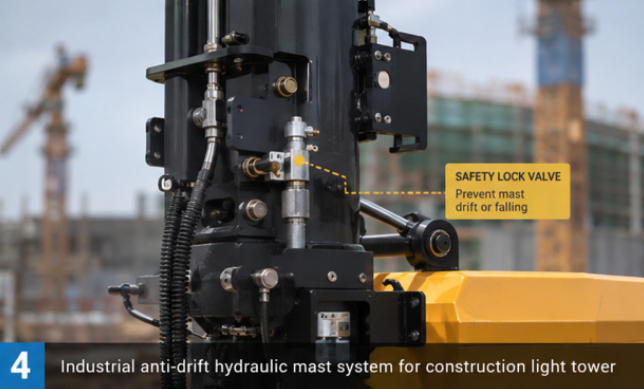
Untuk armada penyewaan jangka panjang dan proyek lingkungan yang keras, prioritaskan menara penerangan yang dilengkapi dengan katup pengunci pengaman terintegrasi, struktur penyegelan multi-lapisan, dan batang hidrolik yang dipertebal. Desain pabrik yang dioptimalkan secara fundamental mengurangi risiko kebocoran, penyumbatan, dan pergeseran, sehingga menurunkan biaya perawatan secara keseluruhan.
Pertanyaan yang Sering Diajukan (FAQ)
Q1: Mengapa tiang hidrolik tenggelam setelah diangkat?
Masalah ini terutama disebabkan oleh katup periksa yang tidak disetel dengan benar, katup pengosongan yang longgar, atau kebocoran internal silinder. Penggantian segel secara berkala dan pemeriksaan katup dapat mengatasi masalah ini.
Q2: Bagaimana cara memperpanjang umur pakai tiang hidrolik?
Pemilihan oli hidrolik standar, pembersihan rutin, pengoperasian terstandarisasi, dan inspeksi harian adalah empat metode inti untuk memaksimalkan umur pakai tiang.
Q3: Apakah kebocoran oli yang sering terjadi merupakan masalah kualitas?
Sebagian besar masalah kebocoran disebabkan oleh keterlambatan perawatan dan abrasi partikel, bukan masalah kualitas pabrik.
Kesimpulan
Kegagalan tiang hidrolik pada menara penerangan bergerak sebagian besar disebabkan oleh masalah penggunaan dan perawatan, bukan cacat bawaan. Dengan mengenali gejala kegagalan yang umum, menganalisis akar penyebab, dan menerapkan langkah-langkah pencegahan yang terstandarisasi, pemilik armada dan kontraktor dapat secara efektif mengurangi waktu henti, memangkas biaya perawatan, dan meningkatkan stabilitas serta masa pakai peralatan.
Jika Anda membutuhkan menara penerangan bergerak kelas industri yang tahan lama, anti bocor, dan anti bergeser untuk proyek Anda, jangan ragu untuk menghubungi kami. hubungi tim profesional kami untuk solusi peralatan yang andal.
Kata kunci: menara penerangan bergerak, tiang hidrolik, perawatan menara penerangan, kegagalan sistem hidrolik, peralatan penerangan konstruksi

 NO.2 XIAHE ROAD GANZHE STREET,MINHOU COUNTY,FUZHOU FUJIAN CHINA


 JARINGAN DIDUKUNG
 Indonesia
 English
 français
 Deutsch
 italiano
 русский
 español
 português
 العربية
 Melayu
